

Warsaw – As legislators in Poland draft a new law aimed at combatting human trafficking, Médecins Sans Frontières (MSF) urges that any measures inscribed in the legislation must not harm children. Children who are migrants are currently exposed to unreliable and inappropriate medical screening methods to determine their age. MSF calls on law makers to reject these methods as part of the law, and to ensure that ethical, comprehensive, and holistic means of assessing a child’s age are included.

A new MSF report, Age as a verdict, written with partners Save the Children and We Are Monitoring, looks at how age‑assessment procedures currently used in Poland are at risk of being formalised in the new law as part of the victim‑identification process. However, these procedures – including dental and radiological methods – are not scientifically reliable and are unethical for use in this context, in addition to carrying significant risks for children. Using these procedures to determine a minor’s legal age leads to harmful consequences; they can be unlawfully denied entry into Poland, and therefore protection and safety.

In the past, we were notified about young people who, shortly after undergoing an age‑assessment test, had been pushed back to Belarus directly from hospitals, still wearing casts and bandages. No-one should be denied care or pushed back from a hospital because of a medical test that was never designed to determine a person’s legal status.
Dr Alice Silvestro
MSF medical coordinator in Poland

The proposed law, “National Action Plan Against Trafficking in Human Beings”, is planned to enter into force no later than 2027. It comes as the government suspended the right for people to seek asylum in Poland in March 2025, and was supposed to be temporary – exceptionally introduced in response to an influx of people along the Polish-Belarusian border – yet it remains in force today. The suspension for seeking asylum does not apply, however, to some groups of vulnerable people, including unaccompanied minors. But there is no effective mechanism for identifying people belonging to those vulnerable groups, including children.

Over the past years, MSF teams providing medical support to asylum seekers in Poland have repeatedly observed the ineffectiveness of age assessment procedures, particularly on unaccompanied minors at the border with Belarus.

“We’ve seen children having to undergo harmful methods of age assessment to prove that they are not adults, to avoid being sent back to Belarus,” says Dr Silvestro. “These procedures have included using ionising radiation, which is not only scientifically unreliable, but it also goes against the fundamental principle of acting in the child’s best medical interest.”

In the case of minors, the initial need to recognise them as individuals under the age of 18 poses a significant challenge when someone does not hold a travel document, such as a passport. This lies within the discretion of officers when they apprehend someone at the border; and is particularly challenging in situations where this occurs in forests, without witnesses, under stress, and with language barriers.

Since March 2025, border guards in Poland have exercised even greater authority over determining a person’s path. They are the ones who decide whether someone is allowed to undergo the full age assessment procedure and apply for asylum. But we know these procedures are flawed; children must be protected rather than exposed to additional harm.
Uriel Mazzoli
MSF project coordinator in Poland

The Act on Combatting Trafficking may offer an opportunity to address these flaws and ensure that any future procedures prioritise child protection, scientific validity, and medical ethics.

“We call on paediatric radiology and endocrinology societies in Poland to take a position on age‑assessment practices and their scientific limitations,” says Dr Silvestro. “Standardised reporting guidelines and a clear affirmation of doctors’ right to refuse participation, without legal or professional repercussions, are essential to ensure ethical and effective methods, and safeguard children’s rights.”

COVID-19 in India: “We’re just not able to find enough nurses”

Premananda Hessenkamp/MSF

By Dilip Bhaskaran, Project Coordinator, Mumbai COVID-19 project

We have been collaborating with the Municipal Corporation of Greater Mumbai (MCGM) to co-manage dedicated Jumbo COVID-19 Care Centre in Bandra Kurla Complex (BKC). MCGM is doing a great job and we started this collaboration during the first wave providing patient care. Now, during the second wave, our role is to improve the quality of care for mild/moderate cases and patient dignity in the BKC facility.

The 2,000-bedded hospital is split into 2 phases, having 1,000 beds in each. Right now we’re managing six wards in Phase 1 and four wards in phase 2 and every ward has 28 beds in it.

"Human resources is the biggest challenge, particularly for nurses. We’re just not able to find enough nurses."
- Dilip Bhaskaran
Project Coordinator, MSF Mumbai COVID-19 project

Even though we are a small part of big operation, our job is very important. Increasing the quality of care these patients receive and managing them well with oxygen in the facility means fewer people will need to go on to ventilator care in ICUs.

Working with everyday challenges

Working on quality of care has two aspects: medical and logistic. On the medical front, the biggest issue is supporting and training new and junior medical staff in the public sector. After the first wave, a lot of doctors moved on to new positions. So now, we’re working with lots of new doctors that are just out of college and need training in patient care and bedside management. It’s the same with pharmacy management and nursing care – the newer staff need supervision. HR is the biggest challenge, particularly for nurses – we’re just not able to find enough nurses.

On the logistical front, there is also a lot to be done. Infection, prevention control (IPC) and, water and hygiene needs to be managed. We’re in the middle of summer and it gets very hot inside the tent. Patients are staying in makeshift wards where the temperature can reach more than 40 degrees. We’re trying to help step by step to drastically improve the quality of care.

Meanwhile, the medics are working in PPE kits for more than six hours in temperatures higher than 40 degrees and in those conditions both patients and healthcare workers lose a lot of water and can become dehydrated. So, we’re also trying to help resolve this issue too.

There are lots of formalities involved and getting problems solved takes a lot of collaboration and work.
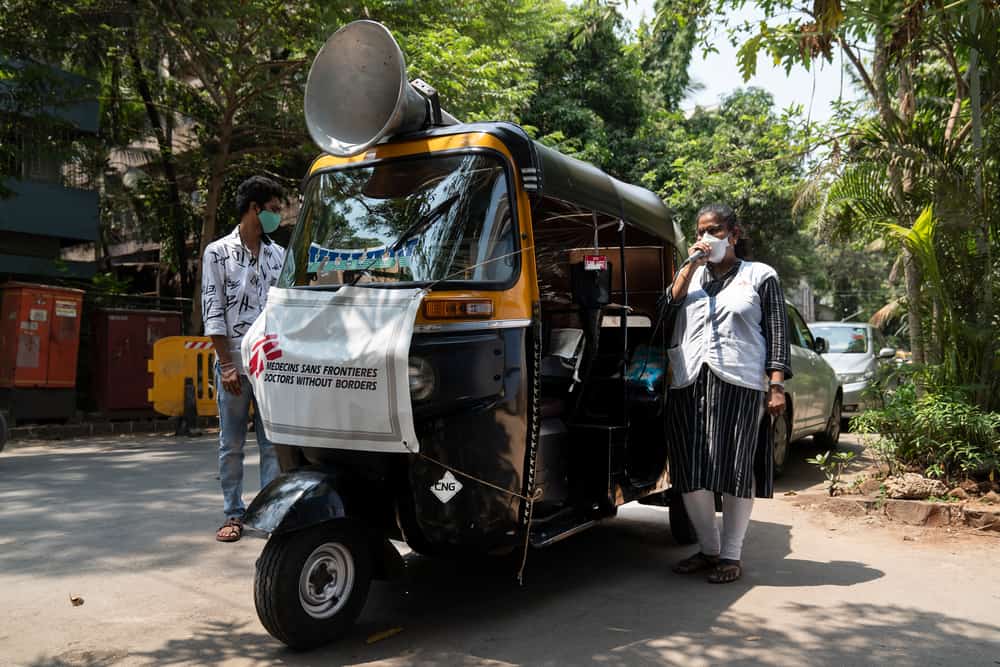
MSF Health Educator Shagufta Sayyed speaks about COVID-19 prevention measures during a mass awareness campaign in Mumbai's M-East Ward. India 2021 © Premananda Hessenkamp/MSF

Helping the community

Outside of the hospital, we’re also expanding our work in the community.  We’ve been working in M-East ward for a long time, running a drug-resistant tuberculosis project. Mumbai is divided into 24 administrative wards and this is the one where there are a lot of needs. It’s a densely populated area and social distancing is a real challenge.  The population is over 800,000 and more than 70% of people here live in informal settlements. These are the most vulnerable communities and our target population for awareness and preventive activities.

Our health promotion teams are putting more efforts to promote COVID-appropriate behaviour and we’re also just about to restart our WASH intervention – cleaning public toilets.  These community toilet blocks can be used by over 1,000 people daily and are in terrible condition. So, these are sites where infection can easily spread.

We are doing well as a team. It is coordinated action and all team members are equally contributing to achieving the set objective. I’m very fortunate to be working with such a great team.  


Show Buttons
Share On Facebook
Share On Twitter
Share On Linkedin
Contact us
Hide Buttons